Designing Flat Plate Stair Stringers in MasterSeries – BS 5950 and Eurocode 3
Flat plate stair stringers commonly carry major-axis bending together with axial compression, while the stair treads may provide regular out-of-plane restraint.
In MasterSeries, these effects are treated separately:
section capacity/classification;
in-plane axial buckling;
out-of-plane axial buckling;
lateral-torsional buckling (LTB);
and finally the combined axial + bending interaction check.
For stringers carrying compression as well as bending, use an Axial with Moments design brief.
The same restraint principle can be used for BS 5950 and Eurocode 3, but the resistance calculations are code-specific.
Worked example
Consider a:
300 × 10 mm flat plate stringer;
S275 steel;
7.1 m stringer length;
stair treads at 345 mm centres;
treads assumed to provide effective out-of-plane restraint.
The MasterSeries design output for this example uses:
| Check | Design length |
|---|---|
| In-plane axial buckling | 7.1 m |
| Out-of-plane axial buckling | 0.345 m |
| Lateral-torsional buckling | 0.345 m |
This arrangement is used in both the BS 5950 and Eurocode calculations.
A simple way to visualise this is that the whole stringer can buckle in the plane of the stair, but the treads can prevent it buckling sideways over more than one tread spacing.
1. Axial buckling lengths
MasterSeries provides separate inputs for the member's major- and minor-axis axial buckling lengths.
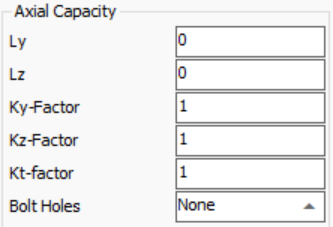
The Axial Capacity Inputs define:
Lx - distance between restraints to the major/strong axis;
Ly - distance between restraints to the minor/weak axis;
Kx and Ky - effective-length factors.
For the example stringer:
In-plane buckling
The stringer is relatively stiff in the plane of the stair. If its effective restraint is provided by the top and bottom supports:
Lcr,in−plane
- Ley = Ky x Ly = 1.0×7.1 = 7.1m
Out-of-plane buckling
Across its 10 mm thickness the stringer is much more flexible.
If each tread and its connection provides effective lateral restraint:
Lcr,out−of−plane
- Lcr = Lez = Kz x Lz = 0.345 m
The engineer is responsible for deciding whether the actual tread and connection detailing justify this restraint assumption.
2. Lateral-torsional buckling
LTB is a separate check from axial buckling.
Under major-axis bending, the stringer can move sideways and twist. Where the treads provide suitable restraint, they can divide the stringer into short LTB portions.

For the worked example MasterSeries checks:
- Le = 1.0×0.345 = 0.345m
in both the BS and Eurocode calculations.
The LTB inputs include the effective-length factor Le, loading type, moment-distribution factors and zg load-height input. Where the member is not fully restrained, MasterSeries uses the separately defined lateral-restraint positions to establish the member portions. (Lateral Torsional Buckling (LTB) Inputs)
3. Flat plate section capacity
The restraint provided by the treads does not automatically remove the flat-plate section classification rules.
BS 5950
For the 300 × 10 S275 flat, MasterSeries reduces the section to an effective depth of 180 mm and reports a semi-compact section.
Eurocode 3
For Eurocode design, MasterSeries follows the flat-plate treatment described in SCI AD 436, using the Class 3 limit:
- b/t≤19ε
(Section Classification in Steel Beam Design)
4. BS and Eurocode LTB treatment
The physical restraint assumption is the same for both codes: suitably restrained treads may reduce the out-of-plane and LTB lengths.
SCI AD 310 provides specific background guidance for flat plate stair stringers to BS 5950. For Eurocode design, AD 391 provides guidance on lateral-torsional buckling of rectangular plates, while MasterSeries uses AD 436 for the flat-plate classification treatment.
5. Combined bending and axial compression
MasterSeries does not simply calculate the separate checks and take the largest utilisation. MasterSeries then performs the EC3 member interaction checks.
This is why an Axial with Moments brief should be used where compression is significant.
6. Can every stair tread be treated as a restraint?
Not automatically, however you can use the Auto Restrain at Incoming Option within the Lateral Restraints Tab to set this (if for example you determine that the treads and risers are fully welded and acting as a 'diaphragm').
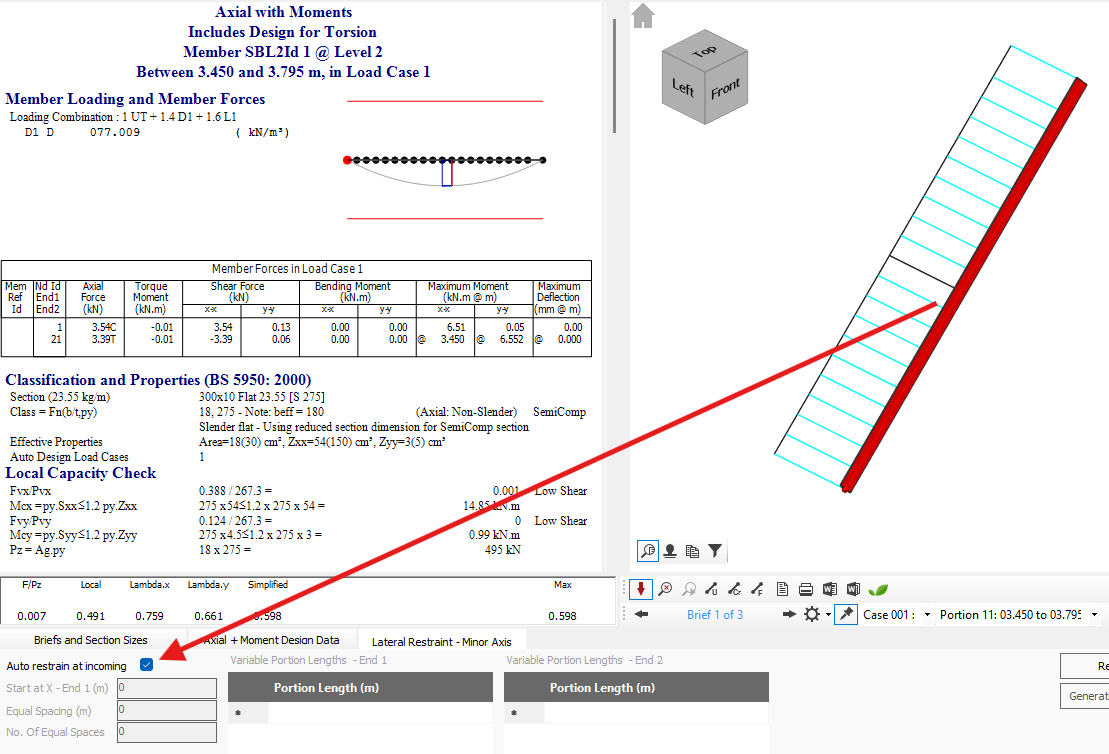
MasterSeries uses the restraint arrangement entered by the engineer; it does not verify whether the physical tread connection is capable of providing that restraint.
Before using the tread spacing for out-of-plane buckling or LTB, consider whether the tread and its connection have adequate strength and stiffness to restrain the relevant sideways movement.
7. Torsion limitation for flat sections
Where eccentric tread reactions or connection details introduce significant torsion, this requires separate engineering consideration.
Recommended MasterSeries setup
For the worked example:
Axial with Moments brief
In-plane axial buckling → 7.1 m
Out-of-plane axial buckling → 345 mm
Lateral restraints for LTB → 345 mm centres
LTB effective-length factor → 1.0L, where appropriate to the assumed restraint condition
The key principle is that the full stair may govern buckling in one direction while the tread spacing governs stability in the other direction.
Related MasterSeries Help
- Axial Capacity Inputs
- Lateral Torsional Buckling (LTB) Inputs
- Section Classification in Steel Beam Design
- Axial with Moments
- Beam and Beam-Portion Design Brief is not suitable where axial force is significant.
- MasterSeries 2025.15.31.