
Section Classification in Steel Beam Design
MasterKey Steel Design requires explicit definition of compression zones, especially for asymmetric sections.
Section classification is sensitive to which side is assumed to be in compression.
If the beam is asymmetrical (e.g. T-sections, plate girders, or built-up I-sections), make sure to correctly set the compression side in the 📄 Lateral Torsional Buckling (LTB) Inputs.
This setting will determine which flange/web elements are classified, which can result in differences such as Class 1 in one module vs Class 3 in another.

Steel Design performs classification strictly based on geometry and loading, requiring careful setup of compression zones, especially for asymmetric sections.
Flat Plate Classifications
Tables 5.1 and 5.2 in EN 1993-1-1 (Eurocode 3) don’t include a direct reference for flat plates. The approach used in the software is based on the guidance provided in SCI Advisory Desk Note AD 436, which clarifies the classification limits for flat plates in bending.
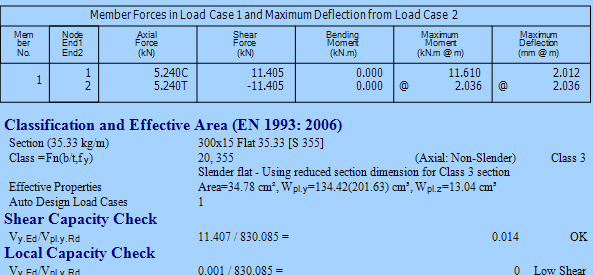
As per SCI AD 436, a flat plate in bending is limited to a Class 3 section, where the width-to-thickness ratio is restricted by the criterion:
- b/t<19ε
This means that for a flat plate, the limiting width is:
- D=19tε
You can find the full explanation and background to this approach in SCI AD 436.