Differential Settlement Considerations in MasterSeries
When modelling a structure with both raft and pad foundations, differential settlement can occur due to the difference in support stiffness between the foundation types. A raft supported on springs is permitted to settle under load, whereas pad foundations modelled as fixed supports do not settle. This difference in stiffness can influence the load distribution throughout the structure, causing some elements to attract more load while others attract less.
One approach within MasterSeries to account for this behaviour is to model both the raft and the pad foundations using spring supports.
Raft Foundations with the Finite Element Module
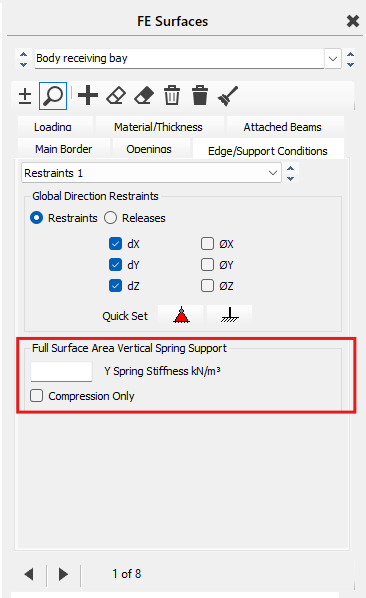
For raft foundations, the spring stiffness is typically based on the subgrade reaction beneath the slab. The Vertical Spring Support options within 📄 Edge Restraints and Releases allow the definition of the supporting soil stiffness beneath the raft.
Pad Foundations with Spring Stiffness
For pad foundations, an equivalent vertical spring stiffness can be derived from the pad bearing area and the supporting soil stiffness. Applying spring supports to the pads provides a more consistent representation of the soil structure interaction across the entire model and allows the analysis to account for differential settlement and load redistribution. Further information can be found under Nodal Spring Supports within📄 Nodal Supports

Iterative Approach
It should be noted that the design of pad foundations may become iterative. As the pad dimensions change during the design process, the bearing area also changes, which can alter the equivalent spring stiffness assigned to the support. Revising the support stiffness may subsequently influence the load distribution within the structure and require further refinement of the foundation sizes.
The level of iteration required will depend on the sensitivity of the structure to variations in support stiffness and the degree of accuracy required for the foundation model.
Other Considerations
It is also important to consider how the original foundation loads were obtained. If the loads have been taken from another structural model that does not accurately represent the current substructure arrangement, they may not reflect the true behaviour of the proposed foundation system. The engineer should therefore confirm how the loads were generated and whether any allowance has been made for differential settlement within the superstructure design.