Load Take Down In MasterSeries
Related Manual Entry - 📑 Load Take-down
The yield line analysis is primarily an ultimate limit state check used to determine the wall’s out-of-plane lateral capacity and the associated plastic failure load factor. The accompanying vertical load take-down checks in MasterKey Masonry are carried out separately using empirical, code-based methods.
Types of loads and application heights
The software allows both uniformly distributed loads (dead and live) and point loads to be applied. Point loads are not limited to the top of the wall; they can be applied at any chosen height, for example where a beam or padstone bears partway down the panel.
Section-by-section analysis
Where intermediate lateral restraints are present, such as a floor or ceiling, the wall is divided into a series of separate vertically spanning regions. The program then performs an independent vertical load take-down and buckling check for each region. For cavity walls, the inner and outer leaves can also be reviewed separately, allowing the user to see how self-weight and applied vertical loads are distributed in each leaf.
Because the software now handles more complex and multi-level wall panels, it no longer relies on a single representative position for the whole wall. Instead, each vertically spanning region is assessed individually.
Identifying the critical location
Rather than sampling force at just one level in the wall, the software checks multiple positions within each region to identify the governing result. It then isolates the most critical locations and reports where the axial force and buckling force are highest, together with the relevant effective buckling height.
Load spreading and distribution
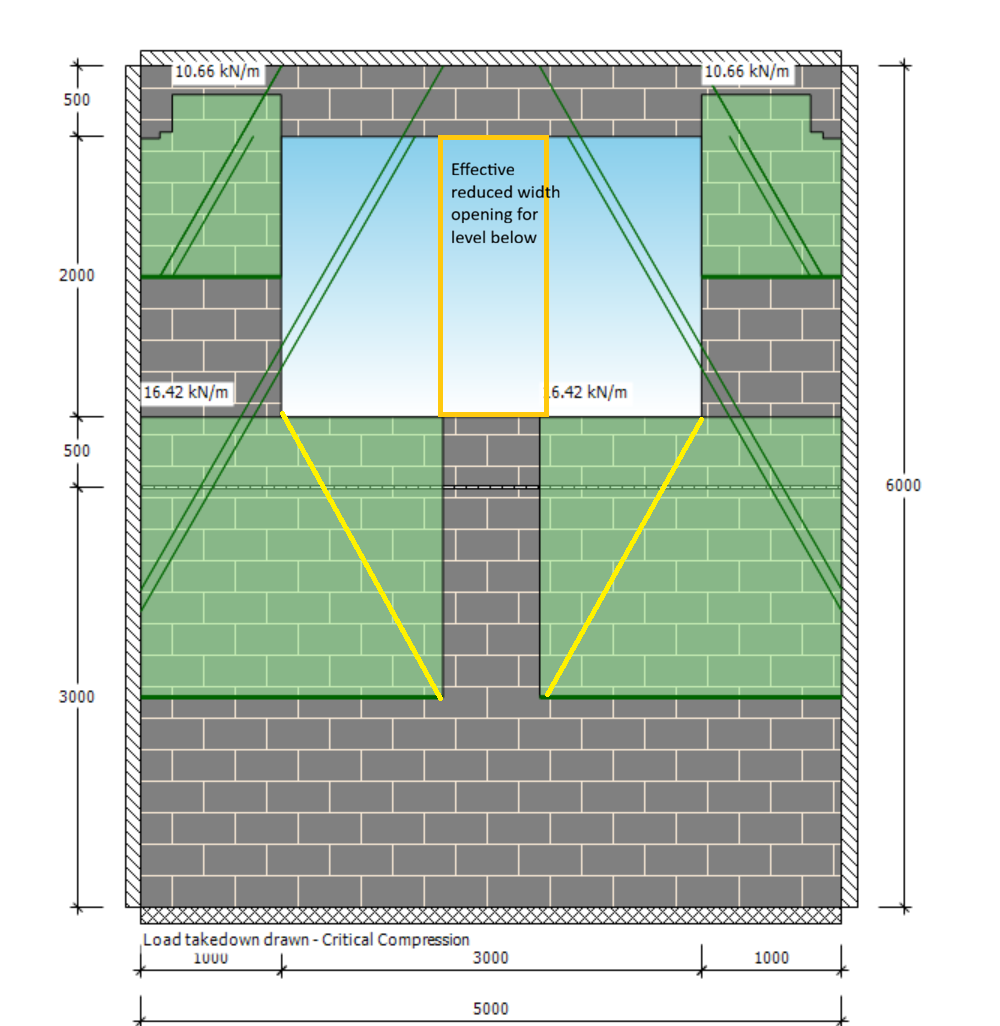
MasterSeries can display the way loads spread through the wall using optional distribution lines. When a point load is applied, the software distributes that load downwards through the masonry in accordance with code-based load spreading rules, typically at an angle such as 60 degrees. The same approach is used for loads above openings.
Within each vertically spanning region, the software samples the resulting forces at a number of heights, such as the mid-height of an individual segment, to determine local axial and buckling effects. After assessing all sample points, it reports the governing case and identifies the exact location where the critical force occurs.
Interaction with yield line analysis
Although yield line analysis is focused on lateral behaviour, the applied vertical loads directly influence the masonry’s bending capacity. For this reason, vertical actions are always included in the AYLA solution. Any change to the vertical loading or wall geometry therefore requires the yield line analysis to be re-run, so that the reported out-of-plane capacity remains accurate.
Distinction between where the load is applied and where the force is sampled for the compliance checks
The design codes require the axial force to be checked at a defined sampling height when carrying out the compression and buckling verifications.

The sampling height depends on the design code:
-
Eurocode (EN 1996-1-1:2005): the force is sampled at mid-height, i.e. 0.5Hc or Hc/2.
-
British Standard (BS 5628 Part 1:2005): the force is sampled at 0.4H down from the top of the wall, or equivalently 0.6H up from the bottom.


Understanding “Max local stress @” and “Max axial buckling force @”
During a vertical load takedown, the software divides a wall panel into a series of separate parts, analysing vertically spanning sections between lateral supports. It samples the forces at various locations within these sections. The program then evaluates all of these sampled locations to determine the worst-case scenarios.
- “Max local stress @” reports the location where the compressive stress in the wall is highest. This is a local compression check, comparing the sampled stress at that point against the masonry design compressive strength.
- “Max axial buckling force @” reports the location where the axial force is most critical for buckling. This force may be averaged over the selected buckling strip width and is then used in the buckling resistance check Fd/Fr.
These two locations are often similar, but they do not need to be identical:
- Max local stress @ = where the wall is most highly compressed
- Max axial buckling force @ = where the wall is most critical for instability
In other words, one is a material strength check, while the other is a stability check.
Treatment of Dead Load Self-Weight in Vertical Load Take Down
The yield line analysis is primarily intended as an ultimate limit state analysis for determining the wall’s plastic capacity and load factor under lateral (out-of-plane) loading. However, these lateral checks are not carried out in isolation from the other actions on the wall.
The MasterKey Masonry module performs a vertical load take-down by dividing the wall into a series of vertically spanning regions, based on the positions of lateral supports. Vertical loads are then distributed through these regions using methods based on the relevant design guidance.
Because the software can now analyse more complex, multi-level panels, it does not rely on a single sampling position for the whole wall. Instead, it carries out the load take-down and buckling assessment separately for each vertically spanning region.
The program samples forces at a number of vertical positions, for example at mid-height of an individual region, to determine the local axial forces. It then reviews all sampled locations and reports the worst-case result, identifying the exact position in the panel where the axial load or buckling force is most critical.
Vertical loads also have a direct influence on the wall’s bending resistance. For that reason, the yield line analysis always includes the applied vertical loads as part of the solution. If the vertical loading is changed, the yield line analysis must be re-run in full, so that the updated out-of-plane capacity reflects the revised interaction between axial load and bending resistance.
Distribution Line 'Gaps'
Sometimes 'gaps' appear on the load distribution graph. These gaps are due to the presence of an opening with a certain distance above the sample line. Effectively we are saying that the load will not be able to spread across the full panel width yet due ot the opening above.
Summary
The vertical load takedown checks in MasterSeries involve several comprehensive processes for analyzing masonry wall panels, particularly focusing on how vertical forces and buckling are evaluated.
Here is a summary of how MasterSeries handles these checks:
- Independent Analysis of Wall Sections: The software divides the wall panel into a series of separate parts for the vertical load takedown. It assesses the vertically spanning sections located between lateral supports and performs a distinct load takedown and buckling analysis for the masonry in each section independently.
- Multi-Level Sampling for Critical Forces: Previously, the software only used a single sample location for the load takedown. Now, it samples forces at multiple vertical levels across the same panel. The program analyzes all of these points to present the worst-case scenario, specifically telling you the exact location within the panel where the axial force is critical and where the buckling force is critical, as well as the relevant buckling height.
- Versatile Load Application: The software accounts for different types of vertical loads, including Uniformly Distributed Loads (UDLs) for dead and live loads, as well as point loads. In the case of cavity walls, loads can be evaluated independently for the inner and outer leaves, accommodating both concentric and eccentric loading scenarios. The software can also show the load takedown separately for each leaf, allowing you to clearly see factors like independent self-weight.
- Flexible Point Load Positioning: A new feature in MasterSeries 2025 allows engineers to specify the exact vertical height of a point load (measured from the bottom of the wall), rather than defaulting to placing it exclusively at the top of the wall panel.
- Accurate Load Distribution: Following standard design code practices, the software distributes forces from point loads or loads located above openings downwards at a specific angle, generally 60 degrees. The program provides visual distribution lines that users can turn on or off to clearly see how the load spreads through the wall and impacts lower sections.