
Member Loading Types
To expand these click on the ‘More Loads’ button.
.png)
Member Load Types
When one of the member load type buttons are pressed, the associated load type is added to the list in the loads editing area. The use of the loads editing area is described above. The purpose and format of each of the load types is described here.
.png)
Standard Member Loads
In the following descriptions the load direction indicator in the load definition is underlined, e.g. in UDLY the Y character defines the load direction. See above for load directions available.
UDLY
Applies a uniformly distributed load W (kN/m) over the full (projected horizontal) length of the member.
D1 UDLY -000.000 ( kN/m )
W (kN/m)
.png)
PY
Applies a point load F in the specified load direction at a distance x measured along the member axis from the lower node number.
D1 PY –000.000 0.000 ( kN,m )
F(kN) x(m)
.png)
PTRY
Applies a partially distributed triangular load starting at a distance x1 with the intensity W1 going to the distance x2 with the intensity W2. All distances are measured from the lower node number.
D1 PTRY –000.000 0.000 0.000 –000.000
W1(kN/m) x1(m) x2(m) W2(kN/m)
.png)
Advanced Member Loads
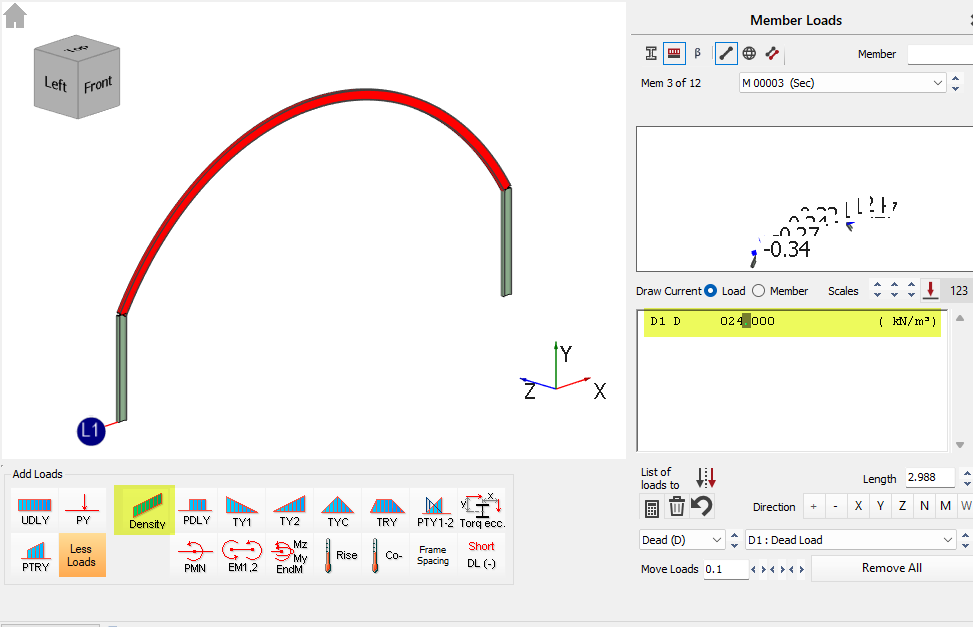
Density
User can over ride the default value for self-weight. Read more under Member Global Density.
PDLY
Applies a partially distributed load W based on the total load F between the x1 and x2 dimensions measured along the length of the member from the lower node number.
D1 PDLY –000.000 0.000 0.000 (kN,m,m)
F (kN) x1(m) x2(m)
.png)
TY1,2
The total load F is distributed over the full member length in a triangular pattern. The distributed load varies from the maximum intensity W(kN/m) at one end of the member to zero intensity at the other end. For TY1 the W occurs at end 1 of the member, and for TY2 W occurs at end 2 of the member. W = F * 2 /L.
D1 TY1 -000.000 ( kN )
F (kN)
.png)
TYC
The total load F is distributed over the full member length in a triangular pattern. The distributed load varies from zero at one end to the maximum intensity W(kN/m) at the centre of the member, then back to zero at the other end . W = F * 2 /L.
D1 TYC -000.000 ( kN )
F (kN)
.png)
TRY
The total load F is distributed over the full member length in a trapezoidal pattern. The distributed load varies from zero at end 1 to the maximum intensity W(kN/m) at the x1 distance, remaining at that intensity to the x2 distance, then returning to zero at end 2 of the member.
D1 TRY -000.000 0.000 0.000 (kN,m,m)
F (kN) x1(m) x2(m)
.png)
PTY1
The total load F is distributed over a partial length of the member in a triangular pattern. The distributed load varies from the maximum intensity W(kN/m) at a distance of x1(m) along the member to zero intensity at the x2(m) distance end. All distances are measured from the lower node number. W = F * 2 /(x2 - x1).
D1 PTY1 -000.000 0.000 0.000 (kN,m,m)
F (kN) x1(m) x2(m)
PTY2
As per PTY1, however with the zero intensity located at x1 and the maximum intensity W (KN/m) located at the x2. W = F * 2 /(x2 - x1).
D1 PTY1 -000.000 0.000 0.000 (kN,m,m)
F (kN) x1(m) x2(m)
.png)
PMN
Applies a uniaxial Point Moment PM in the specified load direction .
- PMN - Point Moment Normal (major axis moment)
- PMM - Point Moment Minor (minor axis moment)
At the distance x1 measured long the member axis from the lower node number.
These follow the MasterFrame Local Coordinate Axis, and not the Global Coordinate system.
D1 PMN +000.000 0.000 (kN.m,m)
M (kN.m) x1(m)
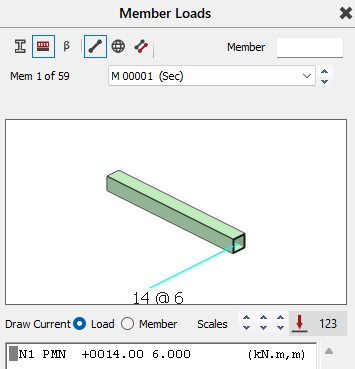
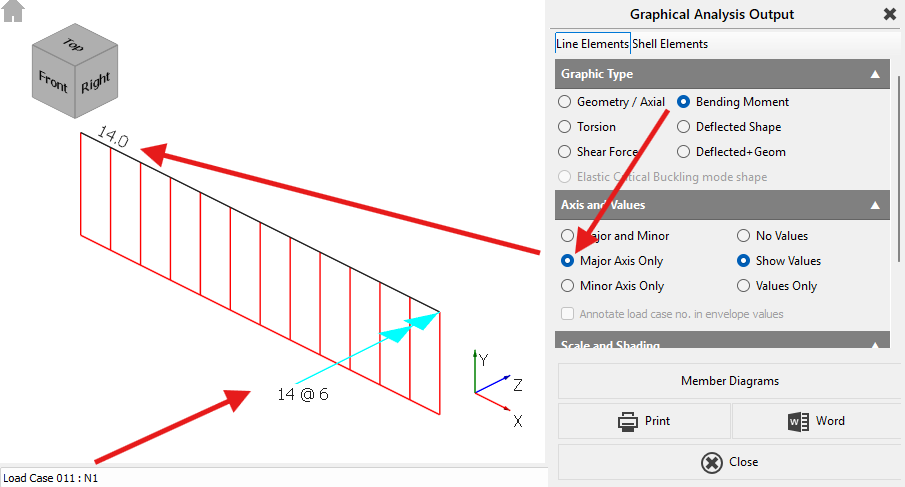
Example PMN - Point Moment Normal (major axis moment) and Sign Conventions
Moment applied as a Positive PMN (major axis moment):
- Load Case: N1
- Load Type: PMN (major axis moment)
- Load Direction + (positive)
- Force: 14kN.m
- Distance: 6m (from lower node 1)
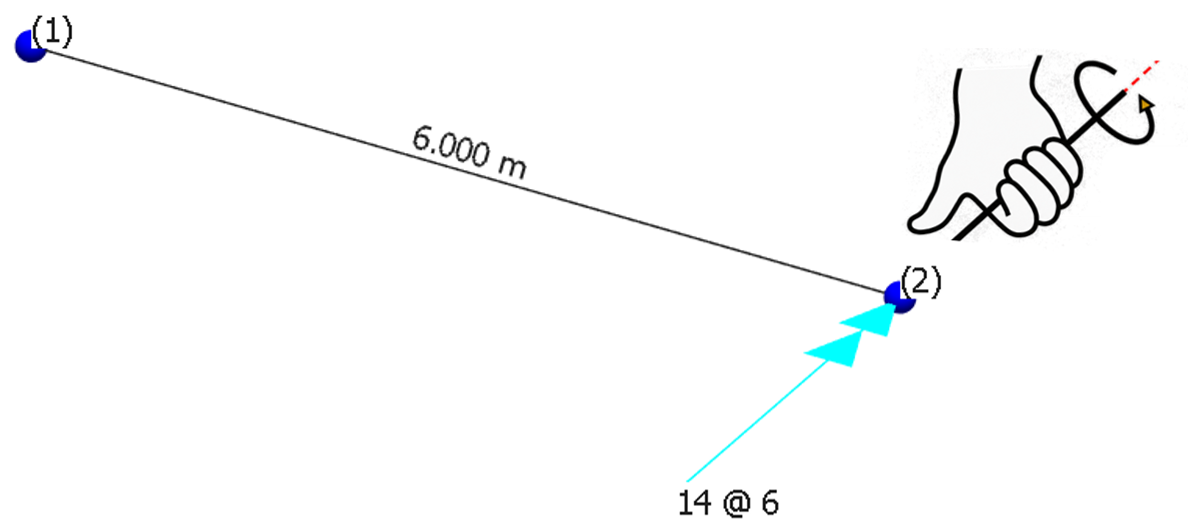
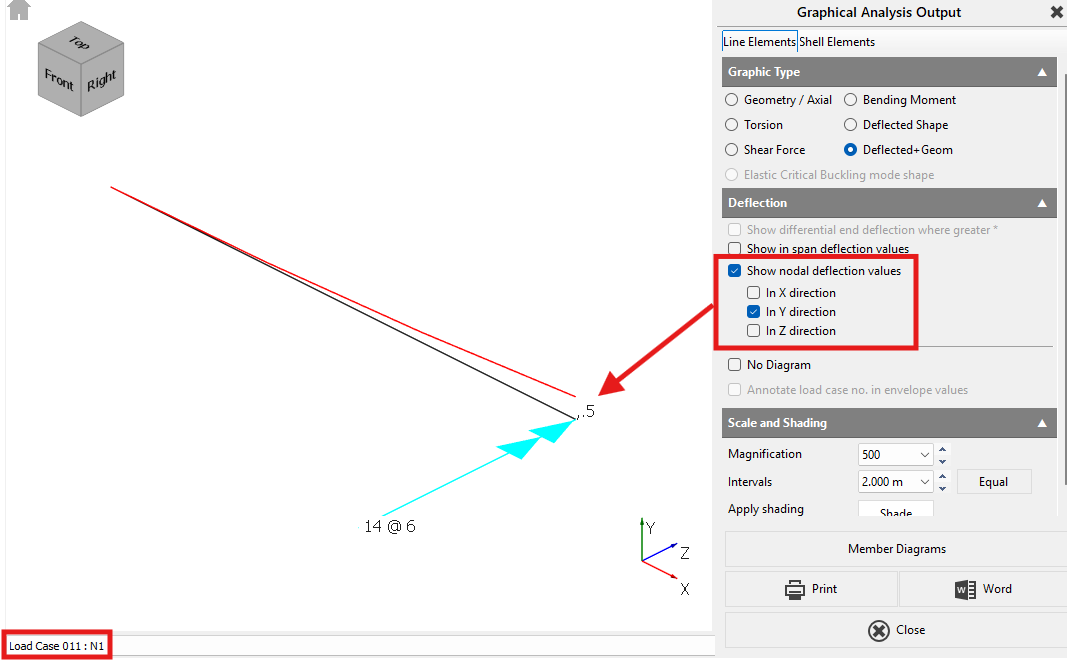
Deflection and Free Body Diagram Checks:
EM1,2
Applies uniaxial moments M1 and M2 to the local major axis of the member at end 1 and end 2 respectively. Note that no other load directions apply in the load type.
D1 EM1 +000.000 EM2 +000.000 (kN.m)
M1(kN.m) M2(kN.m)
EndM
Applies biaxial moments Mz (major) and My (minor) at the specified end (1 for member start, 2 for member end).
D1 EndM 1 +000.000 +000.000 (Mz, My)
D1 EndM 2 +000.000 +000.000 (Mz, My)
Mz(kN.m) My(kN.m)
Density
Applies a local density to a member. This option should not to be used in conjunction with the global density option found from the Properties or Loads menus, which automatically applies a single density to all members in the structure.
D1 D 024.000( kN/m3 )
D (kN/m3)
Rise
Defines the temperature differential on a member for the application of thermal loading.
D1 DT +000.000 (Degree C)
Co-
Applies a Co-efficient of thermal expansion to the member. This is more of a material property of the member rather than a load. Thermal loading is not applied to the member until a temperature differential value is applied through the Rise load type. See above.
Like the density a global value of thermal expansion co-efficient can be applied to all member from the Properties menu, in which instance this local member definition should not be used. The value of the co-efficient represents the amount of thermal strain that is produced through a 1 degree Celsius rise in temperature.
D1 Alpha 12.0E-6 (Thermal Expansion)
Short
Applies a shortening of a member along its length. This will result in the strain due to the shortening of the member being taken up in the rest of the frame. Note that the shortening is defined in metres.
D1 DL -00.000 (m)
Torq ecc
The torq ecc. has the effect of offsetting the member loads from the shear centre of the member in both the members local major (ey) and minor axis (ex), hence creating a torque load on the member. The torque eccentricities specified apply to all member loads that follow after it in the list of loads applied to that member. Hence the following example shows how a UDL on a member is made eccentric by 50mm from the minor axis to create a torque force, while the point load remains applied relative to the shear centre of the member.
D1 PY 050.000 01.550 ( kN, m)
UT Torq ex +0.050 ey +0.000 ( m, m )
D1 UDLY 015.000 ( kN/m )
For further information on applying torsional loads and loading on asymmetrical members and their shear centres follow this technical note link - 📄 Defining Torsional Loads
Frame Spacing
The frame spacing has the effect of multiplying all loads that follow after it in the list of loads by the specified factor. The frame spacing value is entered in meter units. For example, when using a frame spacing along with a UDL, the value entered for the UDL can be thought of as the area (kN/m2) load since it will be multiplied by the spacing value.
UT Spacing 01.000 (Multiply All Loads)
- The 0.25 * Ncr is rearrangement of EN 1993-1-1:2005 eqn 5.8, which is how the same check is presented in EN 1993-1-1:2022.
- Note that in steel design the Ncr values for major and minor axis for this check used the unfactored length (hinged ends) as per EN 1993-1-1:2005 5.3.2 (6).
- The Ncry (major axis) is based on the member length or the Ly manual input in design brief if specified.
- The Ncrz (minor axis) is based on the laterally restrained portion length or the Lz manual input in the design brief if specified.
MasterSeries Member Loading Examples
Beam Layout
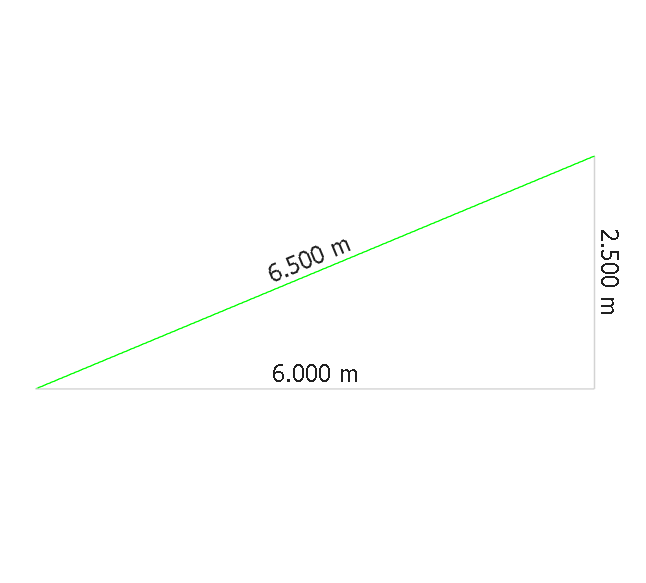
All of the subsequent examples are based on a 6.5m long member, with a horizontal projection of 6m and a vertical projection of 2.5m. In the examples below, the orthogonal projection length of the member is dependent upon the direction of load.
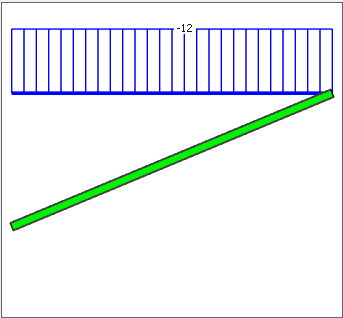
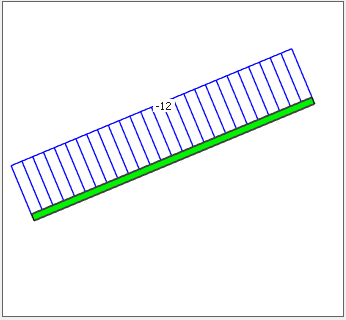
UDLY / UDLX / UDLZ
Uniformly distributed load acting over the full orthogonal projected length of the member.
UT UDLY -012.000 (kN/m)
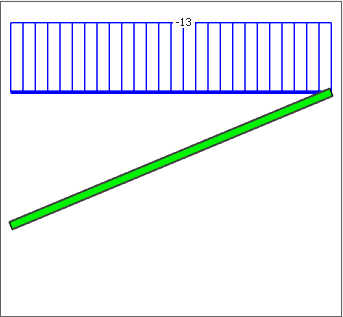
UDLW
Uniformly distributed load acting over the full orthogonal projected length of the member, factored to represent the true (inclined) length of the member.
UT UDLW -012.000 (kN/m)
UDLN / UDLM
Uniformly distributed load acting normal (perpendicular) to the major / minor axis of the member. Example shows a uniformly distributed load of 12kN/m acting normal to the major axis of the member.
UT UDLN -012.000 (kN/m)
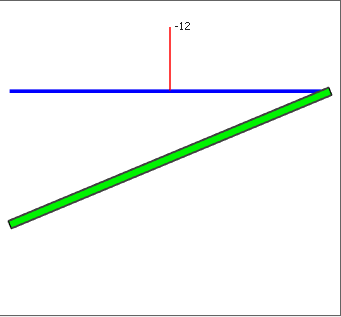
PY / PX / PZ
Global point load located at mid-point of the beam, load position is based on member length and not on the member orthogonal projection.
UT PY -012.000 3.250 (kN, m)
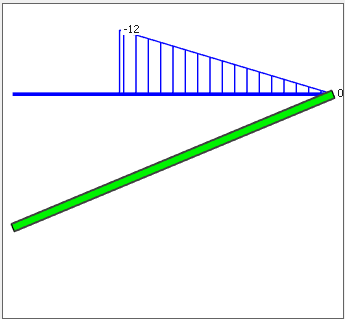
PTRY / PTRX / PTRZ
Partially distributed trapezoidal Load, load position is based on member orthogonal projection and not on member length.
UT PTRY -012.000 2.000 6.000 -000.000 (kN/m, m, m, kN/m)
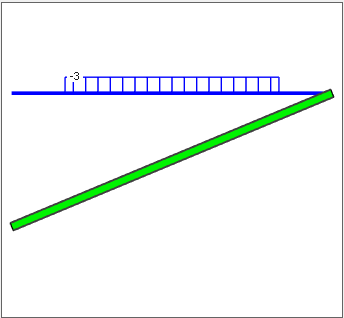
PDLY / PDLX / PDLZ
Concentrated Force converted to a Partially Distributed Uniform Load. End points of the load are set according to the member length, and the load is spread according to the associated orthogonal projection. The example shows the load starts at 1.083m measured along the length of the member, and ends at 5.417m measured along the length of the member. The resulting orthogonal projection of the load is 4m, therefore 12kN / 4m = 3 kN/m
UT PDLY -012.000 1.083 5.417 (kN, m, m)
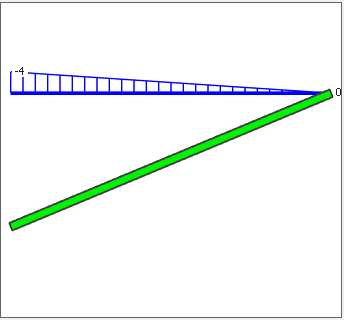
TY1 / TY2
Concentrated force converted to a full triangular load, based on orthogonal projection of member.
2 * 12kN / 6m = 4kN/m (max)
UT TY1 -012.000 (kN)
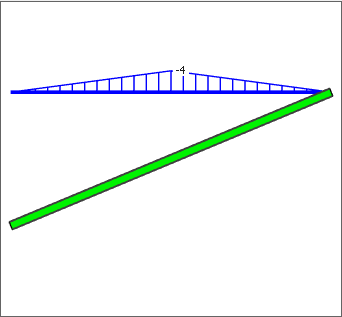
TYC
Concentrated force converted to a symmetric trapezoidal load, based on orthogonal projection of member.
2 * 12kN / 6m = 4kN/m (max)
UT TY1 -012.000 (kN)
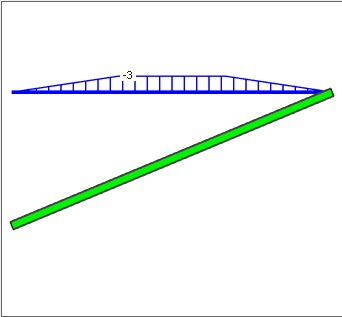
TRY / TRX / TRZ
Concentrated force converted to a symmetric trapezoidal load.
UT TRY -012.000 2.166 4.332 (kN, m, m)
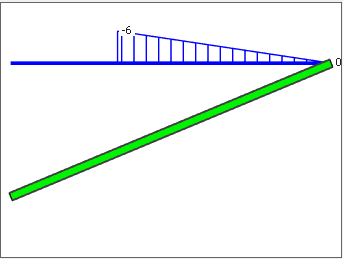
PTY1 / PTY2
Concentrated force converted to a partial triangular load over a segment of the
member, load position is based on member length and not on member orthogonal projection, but load spread is based on the orthogonal projection of the load.
2 * 12kN / 4m = 6kN/m (max)
UT PTY1 -012.000 2.166 6.500 (kN, m, m)
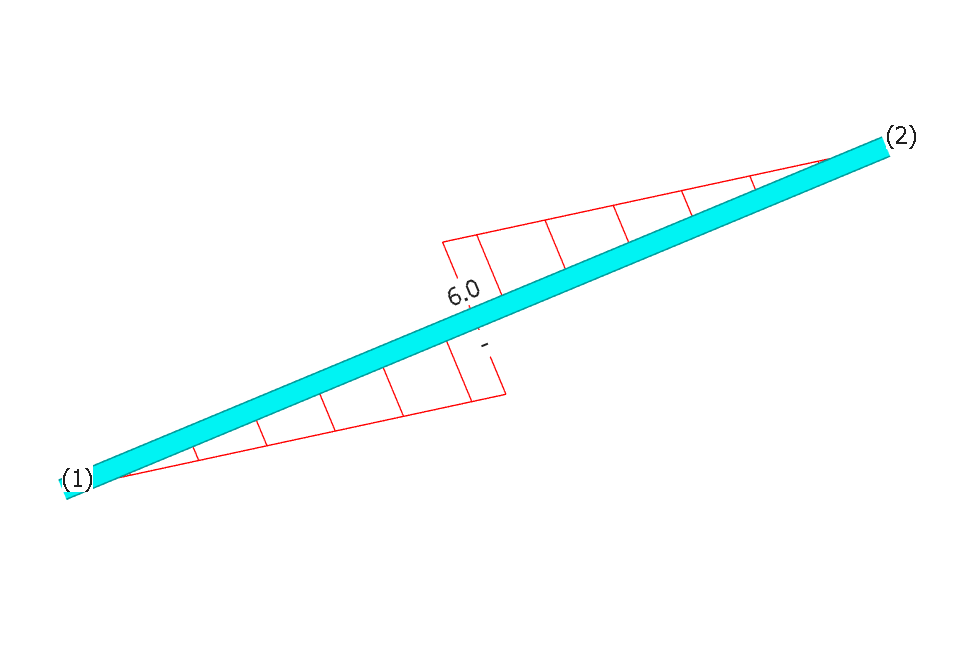
PMN / PMM
Member Point Moment Applies a concentrated bending moment about the member's local major axis (N) or minor axis (M). Direction is defined by the member's node-numbering vector.
UT PMN +012.000 3.250 (kN.m, m)
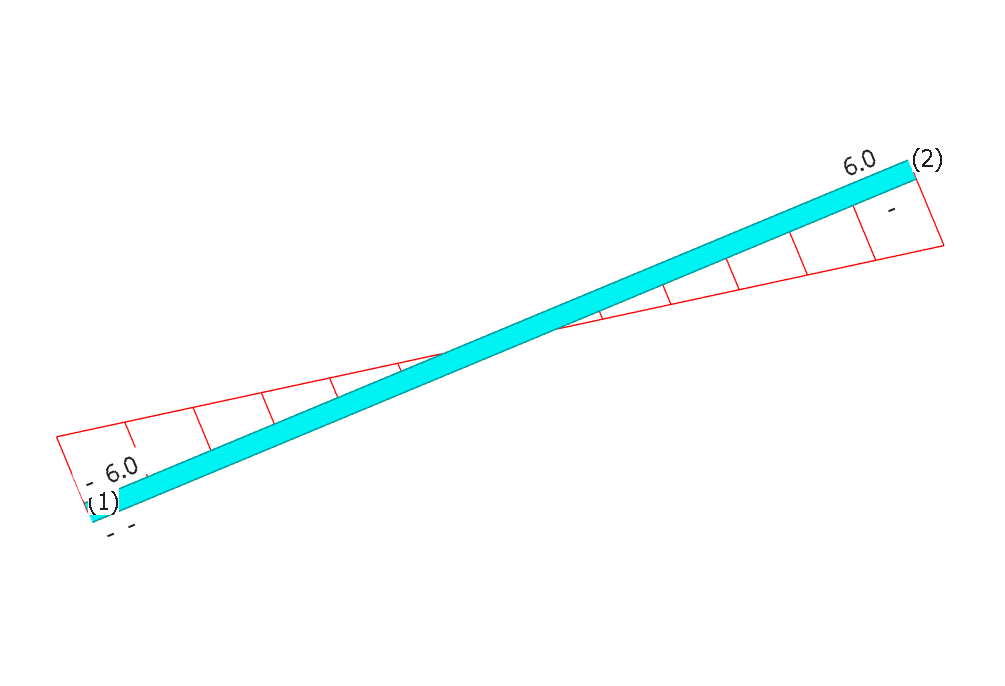
EM1,2
Major Axis End Point Moments Directly assigns concentrated bending moments to the member ends without requiring distance calculations.
UT EM1 +006.000 EM2 -006.000 (kN.m)
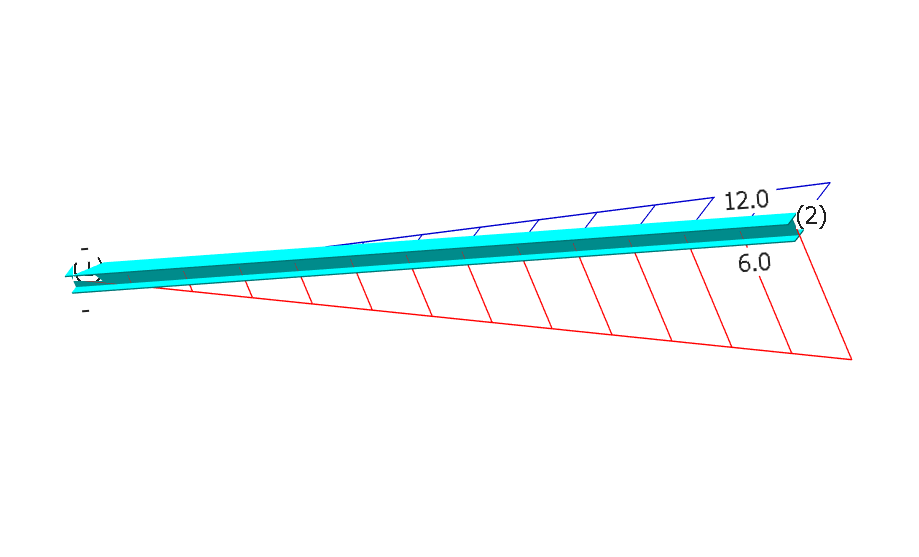
EndM
Major / Minor Axis (biaxial) End Point Moments Applies concentrated moments to both major and minor axes simultaneously at the designated member end (1 or 2).
UT EndM 2 +012.000 +006.000 (Mz, My)
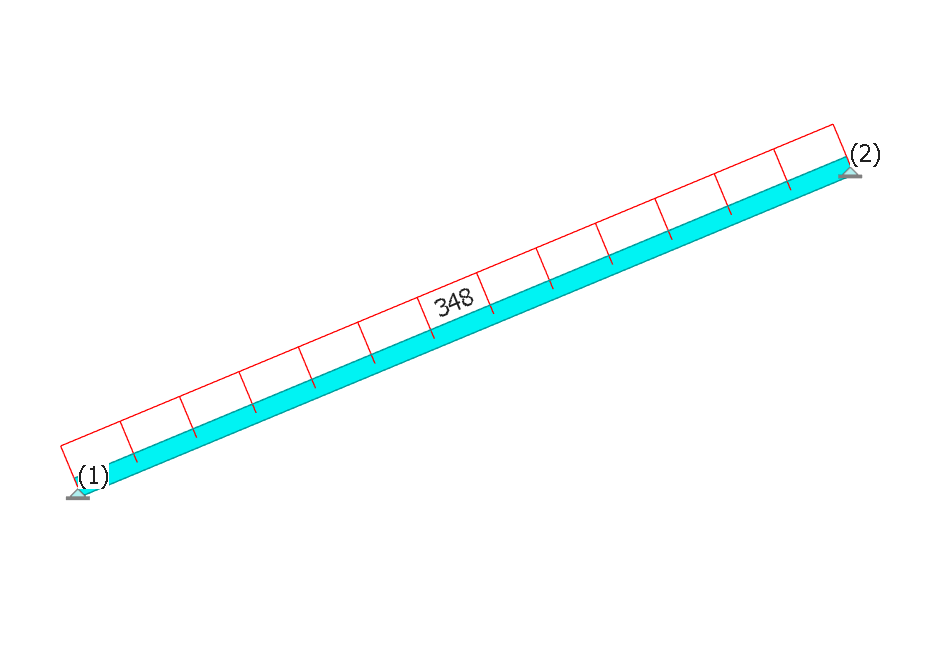
Rise / Co-
When Rise and Co- are used in combination these parameters apply a uniform axial thermal strain, inducing axial deformation or secondary forces in restrained members.
UT DT +030.000 (Degree C)
UT Alpha 12.0E-6 (Thermal Expansion)
Density
Member-Specific Local Density Applies a localized density override directly to a single
member, factored to represent the true (inclined) length of the member. Example shows a density of 78.5 kN/m³ being applied to a 152x152 UC 37.
78.5kN/m³ x 0.00471m2 x 6.5m / 6m = 0.401 kN/m
UT D +078.500 (kN/m³)
Short
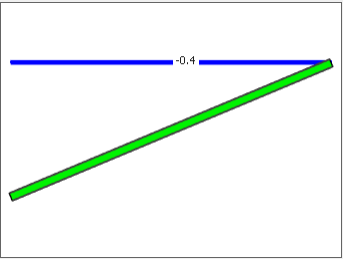
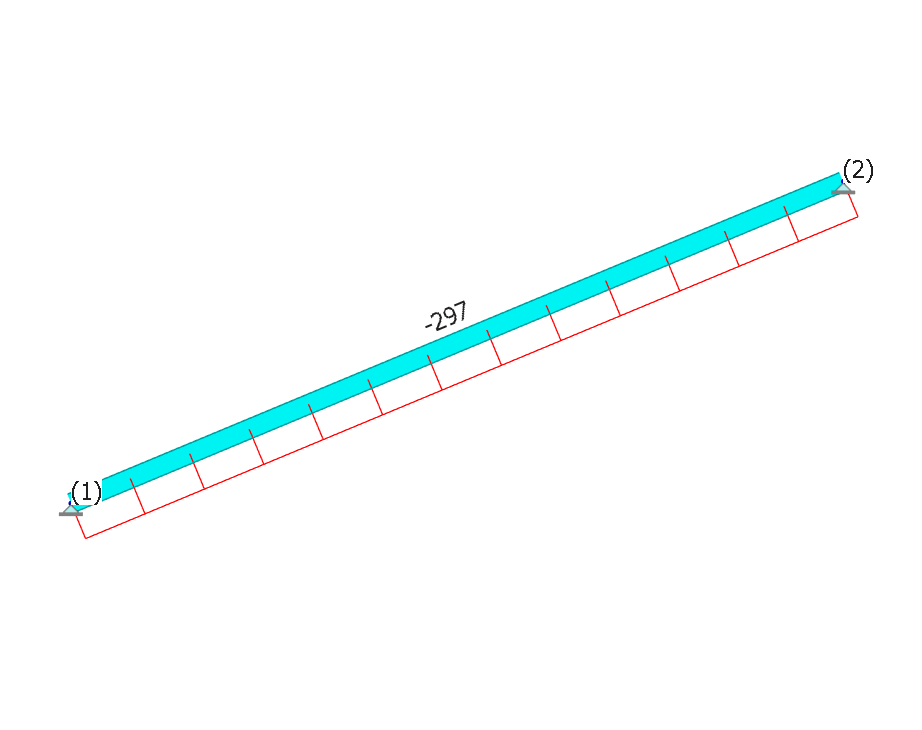
Member Shortening (-ve) or Lengthening (+ve) Forces a physical member shortening (-ve displacement) or member lengthening (+ve displacement) during matrix assembly, distributing the resulting strain through the rest of the frame. Example shows a fully retrained member shortened by 2mm induces an axial tension in the member of 297 kN.
UT DL -0.002 (m)
MasterSeries Member Loading Reference
|
Load Code |
Load Type / Name |
Database Syntax & Default Units |
Parameters Explained |
Spatial Behavior & Analytical Application |
|
UDLY / UDLX / UDLZ |
Uniformly Distributed Load acting over the full (projected horizontal) length of the member. |
D1 UDLY -000.000 (kN/m) |
W (kN/m): uniform load intensity. |
Applied over the orthogonal projected length. |
|
UDLW |
Uniformly Distributed Load acting over the full (projected horizontal) length of the member but factored to represent the true (inclined) length of the member. |
D1 UDLW -000.000 (kN/m) |
W (kN/m): Uniform load intensity. |
Calculation based the true (inclined) length of the member and applied over the orthogonal projected length. Ideal for rafters, staircases, and sloped members. |
|
UDLN / UDLM |
Normal Uniformly Distributed Load. |
D1 UDLN -010.000 (kN/m) |
W (kN/m): Uniform load intensity. |
Acts directly perpendicular (normal) to the local major axis (N) or minor axis (M) of the section. Direction is defined by the member's node-numbering vector. |
|
PY / PX / PZ |
Global Point Load. |
D1 PY -000.000 0.000 (kN, m) |
F (kN): Force magnitude @ x (m): Distance x measured from End 1 (lower node number). |
A concentrated point force acting along global coordinate directions. |
|
PTRY / PTRX / PTRZ |
Partially Distributed Trapezoidal Load. |
D1 PTRY -000.000 0.000 0.000 -000.000 (kN/m, m, m, kN/m)(W1, x1, x2, W2) |
W1 (kN/m): Load intensity @ x1 (m): Distance to start of load from End 1 (lower node number). W2 (kN/m): Load intensity @ x2 (m): Distance to end of load from End 1 (lower node number). |
Applies a partially distributed trapezoidal load. |
|
PDLY / PDLX / PDLZ |
Concentrated Force converted to a Partially Distributed Uniform Load. |
D1 PDLY -000.000 0.000 0.000 (kN, m, m) |
F (kN): Total concentrated force. Distance x1 (m): Start distance of load from End 1 (for distribution). Distance x2 (m): End distance of load from End 1 (for distribution). |
Automatically distributes a total concentrated force (kN) uniformly as a UDL over the partial span defined between x1 and x2. |
|
TY1 / TY2 |
Concentrated Force converted to a Full Triangular Load |
D1 TY1 -000.000 (kN) |
F (kN): Total concentrated force. |
Linearly varying load over the entire member length. Maximum intensity W = 2 * F / L |
|
TYC |
Concentrated Force converted to a Symmetric Triangular Load |
D1 TYC -000.000 (kN) |
F (kN): Total concentrated force. |
Symmetric linearly varying load over the entire member length, peaking at the center
of the member span. Maximum intensity W = 2 * F / L |
|
TRY / TRX / TRZ |
Concentrated Force converted to a Symmetric Trapezoidal Load |
D1 TRY -000.000 0.000 0.000 (kN, m, m) |
F (kN): Total concentrated force. Distance x1 (m): Start distance of flat peak from End 1. Distance x2 (m): End distance of flat peak from End 1. |
Full-span trapezoidal load that maintains peak intensity |
|
PTY1 / PTY2 |
Partial Triangular Load |
D1 PTY1 -000.000 0.000 0.000 (kN, m, m) |
F (kN): Total concentrated force. Distance x1 (m): Start distance of load from End 1. Distance x2 (m): End distance of load from End 1. |
Triangular load over a partial segment of the
member. Peak intensity |
|
PMN / PMM |
Member Point Moment |
D1 PMN +000.000 0.000 (kN.m, m) |
M (kNm): Rotational moment. Distance x1 (m): Application distance from End 1. |
Applies a concentrated bending moment about the member's local major axis (N) or minor axis (M). Direction is defined by the member's node-numbering vector. |
|
EM1,2 |
Major Axis End Point Moments |
D1 EM1 +000.000 EM2 -000.000 (kN.m) |
EM1 / EM2 (kNm): Major-axis concentrated bending moments applied at End 1 and End 2 respectively. |
Directly assigns concentrated bending moments to the member ends without requiring distance calculations. |
|
EndM |
Major / Minor Axis (biaxial) End Point Moments |
D1 EndM 1 +000.000 +000.000 (Mz, My) |
EM1 / EM2 (kNm): concentrated bending moments applied at End 1 and End 2 respectively. Mz (kNm): Major axis moment. My (kNm): Minor axis moment. |
Applies concentrated moments to both major and minor axes simultaneously at the designated member end (1 or 2). |
Rise | Uniform Temperature Change | D1 DT +000.000 (Degree C) | DT (°C): Uniform temperature change acting on the member, used alongside with Co- (below). Input a positive value for a temperature increase (thermal expansion). Input a negative value for a temperature drop (thermal contraction). | When used in combination with the coefficient of thermal exapansion Co- (defined below), this parameter applies a uniform axial thermal strain, inducing axial deformation or secondary forces in restrained members. |
Co- | Coefficient of Thermal Expansion | D1 Alpha 12.0E-6 (Thermal Expansion) | Alpha: Defines the coefficient of thermal expansion applied to the member, defaulted to 12.0E-6 for structural steel. This property dictates how much the material expands or contracts per unit length for every degree change in temperature. | When used in combination with the temperature change Rise (defined above), this parameter applies a uniform axial thermal strain, inducing axial deformation or secondary forces in restrained members. |
|
Density |
Member-Specific Local Density |
D1 D +000.000 (kN/m³) |
D (kN/m³): Custom material density. |
Applies a localized density override directly to a single member. |
|
Short |
Member Shortening (-ve) or Lengthening (+ve) |
D1 DL -0.000 (m) |
DL (m): Shortening displacement (-ve) or Lengthening displacement (+ve). DL stands for Displacement Length (not dead load) |
Forces a physical member shortening (-ve displacement) or member lengthening (+ve displacement) during matrix assembly, distributing the resulting strain through the rest of the frame. |
|
Torq ecc |
Torque Eccentricity Offset |
UT Torq ex +0.000 ey +0.000 (m, m) |
ex / ey (m): Subsequent loads offset distance from the member shear center. |
Offsets all subsequent loads in the member list from the shear center in x or y. This automatically triggers the calculation of St. Venant torsional moments in the solver. |
|
Frame Spacing |
Load Multiplication Factor |
UT Spacing 00.000 (Multiply All Loads) |
Spacing: Tributary spacing dimension which in reality is just a load multiplication factor applied to all member loads in the list. |
Acts as a multiplier for all member loads. Will move to the top of the load list at analysis time to ensure it scales all loads. |
|
PartFix |
Partial End Fixity |
UT PartFix 00.00 --- --- (Mt My Mz) |
00.00%: Bending stiffness percentage. ---: Switches for Mt (torsion), My (minor), Mz (major) at End 1 and End 2 respectively. - : Off |
Applies partial rotational stiffness to member ends. Triggers an on/off switch based on load group combination factors. |