Bending Moment and Shear Drag in MasterSeries Concrete Beams (BS vs. Eurocode)
When performing Reinforced Concrete (RC) beam checks in MasterSeries, users may observe significant differences in reported bending moment values when switching between British Standards (BS 8110) and Eurocode (EN 1992-1-1).
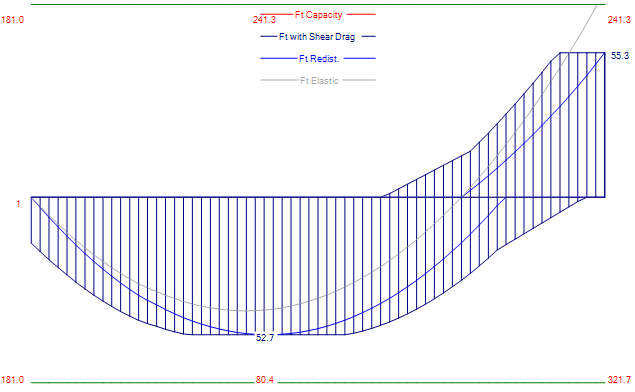
When designing to the Eurocode in MasterSeries, the diagram displayed on the screen is strictly speaking not a standard Bending Moment Diagram; it is actually a Bar Force Diagram that shows the tension force (Ft) in the reinforcement bars.
Because the software is plotting tensile forces rather than pure bending moments, the diagram incorporates an effect known as shear drag. This means that the required tension forces are increased due to the angle of the internal shear force compression strut, which alters the standard hyperbolic shape of a bending moment curve and pulls the diagram outward.
When you apply moment redistribution, you are looking at a combination of three curves on this diagram:
- The faded grey line represents the original elastic curve.
- The blue line represents the redistributed curve, which is then extended or "dragged" by the shear drag effect.
- The outer blue line shows the redistribution
- The red line represents the actual moment/tensile capacity of the provided reinforcement.

The Core Distinction: Moment (BS) vs. Bar Force (Eurocode)
The primary reason for the observed difference lies in what value the software is reporting for the ultimate limit state design:
British Standards (BS 8110): Under BS 8110, the software typically displays the factored bending moment (BM) value. In MasterKey Concrete Design, when the BS code is selected, the bending moment (BM) diagram is displayed.
Eurocode (EN 1992-1-1): When designing to Eurocode, MasterSeries reports a bar force diagram (Ft), rather than a pure bending moment. This Ft value is derived from the formula M/z + Delta_Ftd (referencing Equation 6.18 of EN 1992-1-1:2004). This means that the displayed value on the graphical output for Eurocode is a tension force in the reinforcement bars, not solely the bending moment. This bar force specifically incorporates the effect of shear drag on the bar curtailment requirements and is used at the detailing screen.
Interpreting the Eurocode Ft Value
The Ft value in Eurocode is a more comprehensive design parameter for reinforcement, as it directly reflects the tension required in the steel bars, accounting for factors beyond just the applied bending moment.
- Shear Drag Inclusion: The "Delta_Ftd" component in the Ft formula explicitly accounts for the force attributed to shear stress, which is crucial for determining the necessary anchorage and curtailment of reinforcement, especially near supports or areas of high shear.
- Graphical Representation: In MasterKey Concrete Design, when you are in the Eurocode design environment, the graphical output for beams will show the Ft diagram instead of a traditional bending moment diagram. You can toggle between this Ft diagram and the shear force diagram by double-clicking on the diagram.
Moment Redistribution
Moment redistribution is a technique used in continuous concrete beam design that allows you to take advantage of the plastic capacity of the beam section over the supports at the ultimate limit state. Elastic moments over the supports are reduced, which in turn will force plastic deformation over the supports resulting in moments redistributing from the supports into the beam span. This allows the designer to reduce the typically high negative moments over the supports in order to optimise the reinforcement layout, provided that the resulting moment distribution remains in equilibrium with the applied loads.
Here is how the rules govern moment redistribution, how it is applied in MasterSeries, and how it affects hogging and sagging moments:
Eurocode 2 Rules for Moment Redistribution
Under BS EN 1992-1-1 (Eurocode 2), linear elastic analysis with limited redistribution is permitted without having to explicitly check the beam's rotation capacity, provided certain conditions are met:
- Span and Flexure Limits: The continuous beam must be predominantly subject to flexure, and the ratio of adjacent span lengths must fall within the range of 0.5 to 2.
- Ductility and Neutral Axis Depth: To ensure the concrete has enough ductility to safely form plastic hinges and redistribute the load, the code restricts the allowed redistribution ratio (δ) based on the depth of the neutral axis (xu/d) after redistribution, the concrete strength class (fck), and the ductility class of the reinforcing steel (Class A, B, or C).
- Column Exclusions: The elastic moments derived from frame action must be used without any redistribution when designing the connecting columns.
Application in the MasterSeries Concrete Beam Module
In MasterKey Concrete, moment redistribution is treated as a post-analysis function.
- How to apply it: You can set redistribution values globally across your frame using the 📄 Redistributiontab, or you can tailor it interactively on a beam-by-beam basis in the beam reinforcing editing area.
- User control: You simply input a percentage (e.g., 10%, 20%, or up to the standard 30% limit) to instruct the software to reduce the support moment by that amount.
- Visual Feedback: When applied, the software updates the bending moment (or Bar Force) diagram on your screen. The original elastic moment curve is drawn as a faded grey line, letting you clearly see how much the new redistributed envelope has shifted.
The Effect on Hogging (Top) and Sagging (Bottom) Moments
The distinction between hogging and sagging moments is the core mechanical principle of redistribution. Because the physical loads on the beam remain unchanged, altering the moments at the supports directly impacts the moments in the span to maintain static equilibrium.
- Hogging Moments (Support/Top Steel): Redistribution is almost exclusively used to artificially reduce the peak hogging moments over internal supports. This is highly beneficial because it allows you to reduce the required amount of top reinforcement, easing steel congestion and making the beam easier to construct.
- Sagging Moments (Mid-span/Bottom Steel): When you reduce the hogging moment at the supports, the beam behaves as if the supports are slightly less rigid. This "shifts" the bending forces into the mid-span, increasing the sagging moments. Consequently, heavily redistributing your support moments means you will likely need to increase your mid-span bottom steel to safely accommodate these higher sagging forces.
Setting and Reviewing Design Codes in MasterSeries
To ensure you are designing to the correct code and to understand the context of the displayed values:
- Navigate to the Design menu at the top of the MasterSeries interface.
- Select Design Code and verify that 'Eurocode' is selected, along with the appropriate National Annex (e.g., UK). If prompted to change loading cases, select 'Yes'.
- For concrete beams, the MasterKey Concrete Design module automatically designs and details reinforcement based on the selected code, considering various parameters set in the 'Basic Data & Defaults'.
Verification and Best Practice
While MasterSeries provides powerful automated design capabilities, it is always a good engineering practice to perform independent checks of the results.
- Hand Calculations: Even for complex structures, simplified hand calculations or estimations can provide significant confidence in the magnitude and orientation of forces from the finite element analysis.
- Understanding Outputs: Be mindful that MasterSeries displays results (such as bending moment, shear force, and axial force) relative to the member's local axes. The various graphical outputs, including contour plots and section line diagrams, can assist in interpreting internal forces and displacements across the FE mesh. Detailed design calculations can also be exported for thorough review.
Understanding that the Eurocode's displayed "BM" is actually a bar force (Ft) that includes shear drag effects, as opposed to a pure bending moment under British Standards, is critical for accurate interpretation and validation of your concrete beam designs in MasterSeries.