Section Classification in Composite vs Steel Beam Design
Background:
When designing structural members using MasterSeries, users may notice differences in section classification between the Steel Design and Composite Design modules. This is particularly relevant when working with built-up beams or asymmetric sections.
Section Classification in Composite Beam Design
Yes, section classification is performed in the Composite Design module. However, there is a fundamental assumption in composite construction that alters how classification is applied, particularly for the top flange.
According to SCI P359, Section 4.2:
"With the concrete in compression and the steel beam in tension, the composite cross section is Class 1. The flange class of all UKB sections and all but the lightest UKC sections is Class 1 so that, where the relative size of the steel beam is such that the plastic neutral axis lies below the top flange, the composite beam will still be Class 1. The bending resistance of the composite beam is therefore normally taken as its plastic bending resistance; elastic bending resistance is not considered."
This means:
The top flange is assumed to be fully restrained by the concrete slab.
The composite section is typically treated as Class 1, allowing the use of plastic bending resistance.
Elastic bending resistance is not generally used in composite beam design within MasterSeries.
Section Classification in Steel Beam Design
In contrast, MasterKey Steel Design applies section classification according to EC3 rules without assumptions about composite action.
Key point for asymmetric or built-up sections:
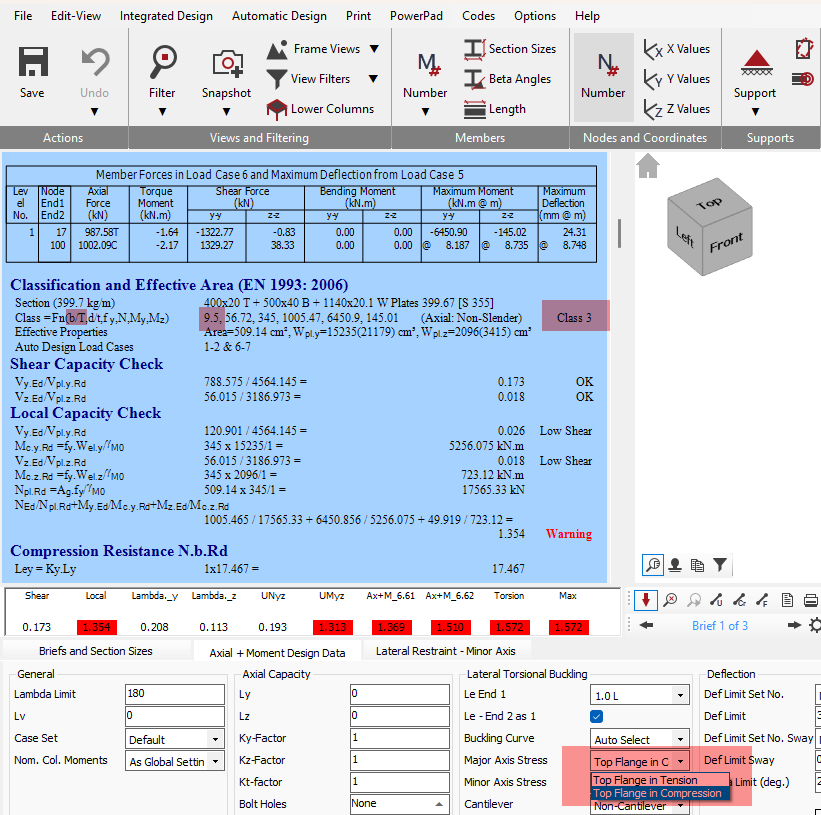
Section classification is sensitive to which side is assumed to be in compression.
If the beam is asymmetrical (e.g. T-sections, plate girders, or built-up I-sections), make sure to correctly set the compression side in the Steel Design module settings.
This setting will determine which flange/web elements are classified, which can result in differences such as Class 1 in one module vs Class 3 in another.
Summary
Composite Design assumes Class 1 for the top flange and typically the full section due to slab restraint and plastic analysis.
Steel Design performs classification strictly based on geometry and loading, requiring careful setup of compression zones, especially for asymmetric sections.
Apparent discrepancies in classification between modules are due to the differing design assumptions and should be understood in context.