Concrete Slab Deflection and Cracking - Overview
The Concrete Slab Deflection and Cracking design is an extension to the MasterFrame: FE Slab Design module. The FE Slab Design module allows users to automate the design of concrete slabs analysed as FE surfaces within Masterframe. The Deflection and Cracking module then allows the user to utilise the reinforcement design to then carry out an additional analysis on the slabs to directly calculate the long term deflection of the slab taking into account the effects of creep, cracking and shrinkage. The Concrete Slab Deflection and Cracking design allows the user to create time dependent loading events, such as striking of the concrete, construction loading, partition erection and final live loading and to assess the effects that these have on the cracking and deflection of the slab. The design then gives outputs of the deflections at each time step along with crack ratios to indicate the extent of cracking in graphical outputs which can be exported as part of a design report. The software then gives outputs of the long term deflections of the slabs.
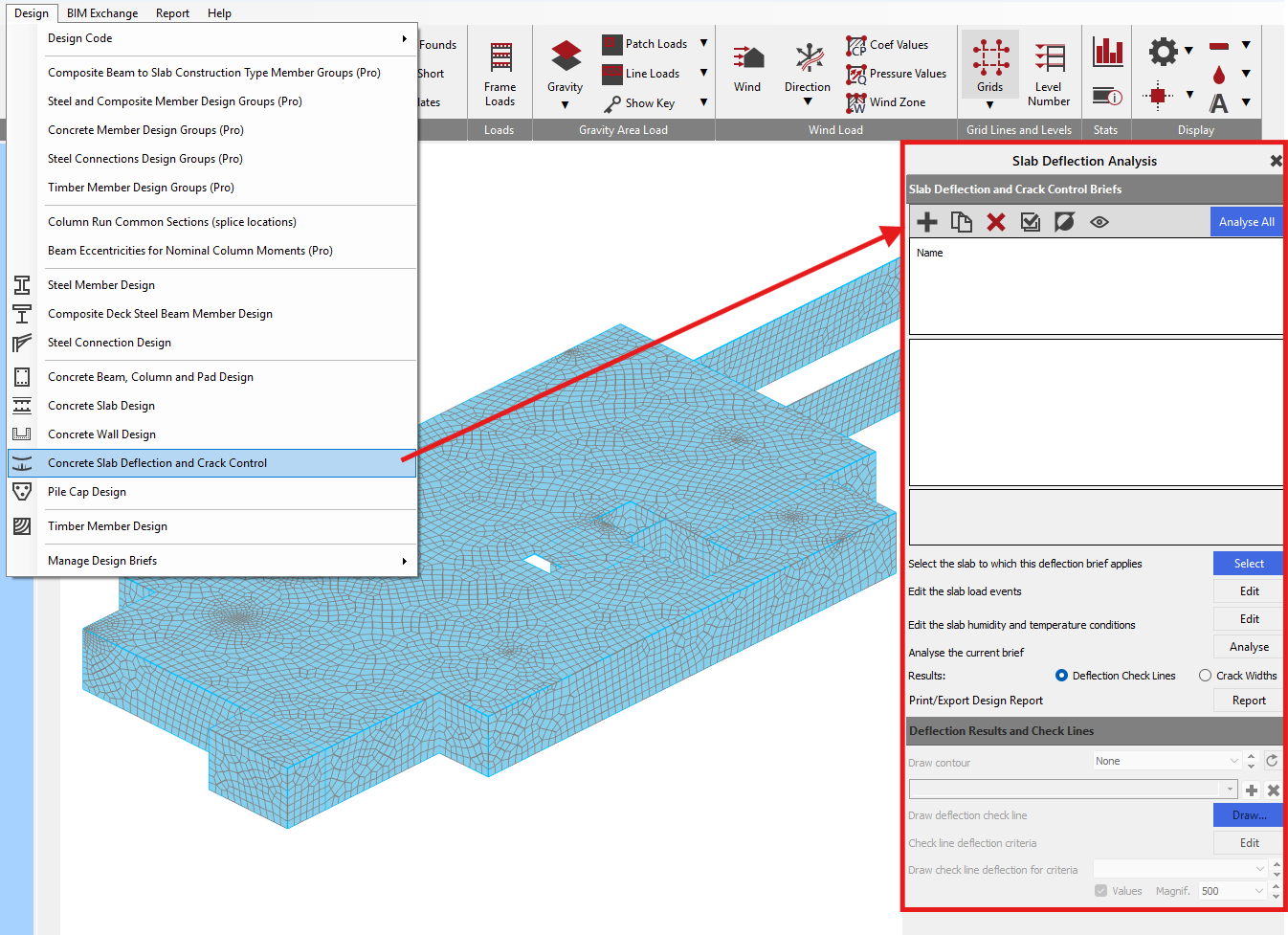
In addition to the calculation of the long term deflection, the module also calculates the maximum crack widths in accordance with EC2.
Why calculate deflections?
Clause 7.4.2(1) of BS EN 1992-1-1 notes that
"Generally, it is not necessary to calculate the deflections explicitly.."
As noted in the Concrete Centre publication TR58 and EC2, satisfying span-to-depth limits means the deflections may be considered to satisfy the deflection limits set out in the code. However, Clause 7.4.2 goes on to note that:
"More rigorous checks are necessary for members which lie outside such limits, or where deflection limits other than those implicit in simplified methods are appropriate."
The limits inherent in a span-to-depth check are not explicitly stated, nor does the code provide guidance on when members lie outside the limits of application. Therefore, there are not clearly defined limits on when deemed to satisfy criteria are appropriate, nor clearly defined parameters on when deflections should be explicitly calculated. However, in the following cases, span-to-depth ratio based acceptance criteria may no longer be valid and the calculation of deflections may be advised:
- End user deflection limits are specified which are more onerous than those recommended in the design codes
- Brittle elements or finishes require enhanced protection by limiting absolute deflection values
- Determining cambers on members
- long span structures where span-to-depth ratios would result in large absolute values of deflection and deflection needs to be limited to a maximum value
- Use of thinner and so lighter structures that would not comply with span-to-depth ratios would result in a more economic structure
- Evaluating structures under specialist or unique loading conditions
- Construction sequences require early age loading to be applied to the structure and induced cracking may lead to increased long term deflections
- The use of high moduli concrete results in higher early strengths enabling early age loading
- The presence of glazed curtain walling where tolerance on vertical movements can be small
With a tendency towards longer span structures, the use of span-to-depth ratios may no longer be appropriate since the magnitude of the span may result in a deflection limit that is itself of sufficient magnitude that it may be detectable visually. Even in cases where span-to-depth ratios would be deemed appropriate, the geometry of the structure may make the determination of the appropriate span difficult. For example, irregular column layouts or curved edges where the slab is part cantilevering may lead to difficulty in determining the required span.
It needs to be recognised, however, that the rigorous method of calculation of deflections is not exact and thus the resulting deflection calculations are still subject to uncertainty. This uncertainty needs to be considered when considering the magnitudes of the calculated deflections.
.png) the effective modular ratio
the effective modular ratio
.png) the first moment of area of the reinforcement about the centroid
the first moment of area of the reinforcement about the centroid