Shear Connection
The Shear Connection panel allows you to refine how shear connectors are counted and how minimum shear-connection rules are applied. These settings affect the degree of shear connection, stud resistance, and the reinforcement required in composite design.
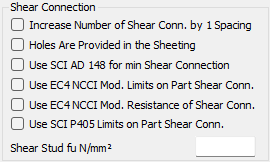
Increase Number of Shear Conn. by 1 Spacing
Start setting-out of deck troughs or studs closer to the ends of the beam so that one additional spacing can be provided.
For example:
A 7.2m long beam with studs at 200mm centres could accommodate either 35 studs (34 spaces) or 36 studs (35 spaces), depending if the run begins at 200mm or 100mm.
This option gives the user direct control over this adjustment, ensuring the design reflects the intended detailing.
Holes Are Provided in the Sheeting
If pre-punched holes are used in the decking to allow the studs to be welded through the deck, the sheeting does not contribute to the transverse reinforcement around the stud.
In these situations:
The longitudinal shear capacity of the slab is reduced,
Additional reinforcement may be required to satisfy longitudinal shear checks in the slab.
Tick this option whenever the deck is perforated at the stud locations.
Use SCI AD 148 for Minimum Shear Connection (Enabled automatically under BS)
SCI AD 148 provides guidance on the minimum degree of shear connection for BS 5950 designs.
Enable this option when evaluating shear-connection requirements in BS-based composite design.
NCCI and SCI P405 Options (Enabled automatically under EC4)
For Eurocode design, MasterSeries automatically applies the more modern SCI and NCCI guidance. These include:
Use EC4 NCCI Modified Limits on Partial Shear Connection
From NCCI PN002a-GB, providing improved rules on how partial shear connection is limited.
Use EC4 NCCI Modified Resistance of Shear Connectors
From NCCI PN001a-GB, which adjusts stud resistance for concrete ribs, transverse deck orientation, and stud positioning.
Use SCI P405 Limits on Minimum Degree of Shear Connection
SCI P405 significantly revised the minimum shear-connection requirements for EC4, introducing separate rules for:
Normal loading
Heavy loading
Very heavy loading (outside P405 scope)
P405 typically reduces the minimum degree of shear connection from the EC4 default of 40% where conditions allow.
These EC4 modifications are shown greyed out because they are automatically applied when the design code requires them.
Shear Stud fu N/mm2
Characteristic tensile strength of shear studs (N/mm²)